


Introduction
Ever since CBT4T became therapist-supported as an online programme for tinnitus distress in 2018 – first in 2018 as the online 6 module Tinnitus E-Programme (previously from 2009-2018 it had been online but entirely self-directed), followed by its significant enhancement in to a Cognitive Behavioural Programme in 2020 specifically developed for individuals with a Tinnitus Functional Index (TFI) Category 4 or Category 5, 54-72% or 73-100% respectively, one of the “unknowns” was whether online learning could be as effective as working one-to-one.
No one could have been more surprised than I when, a few months after its launch in July 2020, people who had enrolled were sending in their repeat TFIs (and the additional clinical measures for anxiety and stress) that were consistently achieving similar levels of improvement to those I worked with 1-1 who attended my NHS tinnitus clinics and latterly, my clinic in Lancashire.
The findings were surprising to me, but also very welcome. The cost of one-to-one working was prohibitive to the majority seeking help.
2020-2025
Year on year, there were changes made to improve CBT4T as an online learning programme. The process hasn’t changed – it is the same process I have used in my clinics going back 20 years. What needed refining was having the process work for people accessing it as an online programme. Between 2020 to 2025, there were five editions, and at the end of 2025, the sixth edition became CBT4T Online.
CBT4T Online in 2026
The benefit of at least one appointment is to have the opportunity to ask questions and discuss issues pertinent to your situation. One of the later refinements was merging the first one-to-one appointment with a repeat of the two main clinical measures – the Tinnitus Functional Index (TFI) and the Anxiety/stress Symptoms Questionnaire (ASQ) at the end of Stage 4*.
This Stage 4 change was first introduced in the CBT4T 2025 version (fifth edition of the programme), and alongside the other “tweaks”, led to the current CBT4T Online.
*Prior to this change, a first appointment came after Stage 3 had been completed, and the first repeat of all clinical measures at the end of Stage 6. The change was prompted by notable improvements in TFI and other clinical measures by the end of Stage 6 following the addition of the Costs & Benefits Transaction tool in Stage 4 and the introduction of a weekly SITREP, both since 2023.
Testing the Water
The reason why I have put in so much effort over these last 6 years to refine and re-refine the online delivery of the CBT4T process is for there to be something widely available that is evidence-based, easy to use and affordable.
After all the work that has gone in to developing CBT4T and the consistent results people achieve through using it, I believe that CBT4T can now be used without one-to-one appointments if people so choose. It wouldn’t be my choice or my recommendation; however, some people may prefer it. There is the cost to take in to account, too.
This is what “Testing the Water” is about. Since June, there has been CBT4T enrolment with £20/month Subscription. The first person to enrol with monthly subscription is close to completing the programme (at the time of writing this article), and he has done so without adding a one-to-one appointment. His initial (pre-CBT4T) TFI was 51.6% (category 3: 32-53% moderate problem); by Stage 4, 51.6% had reduced to 27.6% and by Stage 6, reduced to 18.8%.
This outcome is easily equivalent to enrolment with appointments included. Time will tell if others’ outcomes follow suit. The current plan is to run the monthly subscription enrolment for 6 months, and then review whether or not to continue. £20/month is easier to finance than a lump sum for many people, but interestingly, take up so far is very low indeed.
Another CBT4T audit or something more in depth?
An audit of Clinical Outcomes was last carried out in 2022 (long before the interim Stage 4 repeat of TFI & ASQ was inserted to precede those at Stage 6 from December 2024, and enhancements to improve CBT4T as an online learning programme during 2024/5), so another audit of Outcomes would be useful.
Measuring the Ocean
A few weeks ago during July and early August, collating Outcomes for an audit began. However, there was more data to explore this time compared to 2022 because of the repeat TFI and ASQ measures at Stage 4.
What started as a straightforward audit, turned into a more in-depth study of not only TFI Outcomes, but a study of the changes that people achieve for the eight TFI Subscales:
Intrusiveness
Sense of Control
Cognitive
Sleep
Auditory
Relaxation
Quality of Life
Emotional
Title of the 2026 CBT4T Study:
“What changes are reflected in the TFI Subscales as individuals progress through the CBT4T process?”
The “ocean” of data comes from TFI Subscales changes from enrolment (initial TFI) to Stage 4, to Stage 6 and Stage 7/8.
Clinical Significance (Minimal Important Change – MIC)
The Tinnitus Functional Index (TFI) has 25 questions in total, three questions for seven of the 8 subscales; four questions for the Quality of Life subscale.
According to Fackrell et al (2022) in their article Integrating Distribution-Based and Anchor-Based Techniques to Identify Minimal Important Change for the Tinnitus Functional Index (TFI) Questionnaire, the originators of the TFI (Meikle et al, 2012) proposed a reduction in TFI scores of 13 points as a preliminary minimal clinically meaningful score, referred to as minimal important change (MIC). Since then, a range of alternative scores (change of 4.8 to 22 points) have been proposed as representing the minimal change in scores.
In fact, Fackrell et al propose omitting one of the TFI subscales (the Auditory subscale) altogether due to “including these items risks unduly diluting the specificity and sensitivity of the questionnaire”.
The Auditory subscale is included in the TFI used for CBT4T, not because of any disagreement with Fackrell et al, but because from a therapy perspective, how individuals answer the three questions offers useful information to me as a therapist about an individual’s perspective regarding tinnitus interfering with what they hear. In respect of this issue, the first set of results currently being explored and published in the CBT4T 2026 study includes the Auditory subscale. The future plan is to compare Outcomes for both: Auditory subscale included and Auditory subscale excluded.
Fackrell et al (2022) conclude by identifying a minimal important change (MIC) score of −14 points for the TFI whether the Auditory subscale is included or not.
Reference: Fackrell K, Hall D, Barry J, Hoare D.J. (2022) Integrating Distribution-Based and Anchor-Based Techniques to Identify Minimal Important Change for the Tinnitus Functional Index (TFI) Questionnaire, Brain Sciences https://pmc.ncbi.nlm.nih.gov/articles/PMC9220811/
Do the TFI results of people using the CBT4T programme meet the minimum important change (MIC) of a 14 point reduction?
Fig 1 Average Percentage Improvement of TFI scores, comparing initial scores, to those at Stage 4, Stage 6 and Stage 7/8
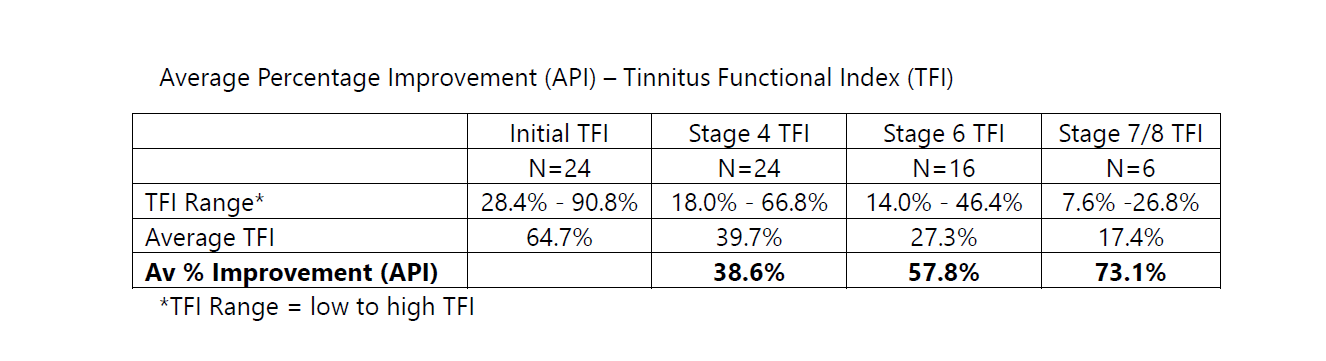
The MIC of -14 points is far exceeded by CBT4T users – even as early as Stage 4.
Fig 1 shows the range of TFI scores for 24 individuals who, at the start of the study had reached at least Stage 4. More than 24 individuals had enrolled since a repeat TFI at Stage 4 became part of the process in 2025, but only 24 had reached Stage 4 and returned their TFI results.
The initial TFI scores of 24 individuals ranged from 28.4% - 90.8%.
By Stage 4, the TFI results ranged from 18.0% - 66.8%
16 individuals had reached Stage 6, with TFI results ranging from 14.0 – 46.4%
6 individuals had reached Stage 7/8 with TFI results ranging from 7.6% - 26.8%
Small numbers are frequently an issue in research projects, and this one is no exception. For this reason, the current study is being extended in to at least 2027, so that many more individuals’ results can be included.
What are the differences achieved in the TFI Subscales?
Fig 2 Average Percentage Improvement for the TFI Subscales at Stage 4, Stage 6 and Stage 7/8
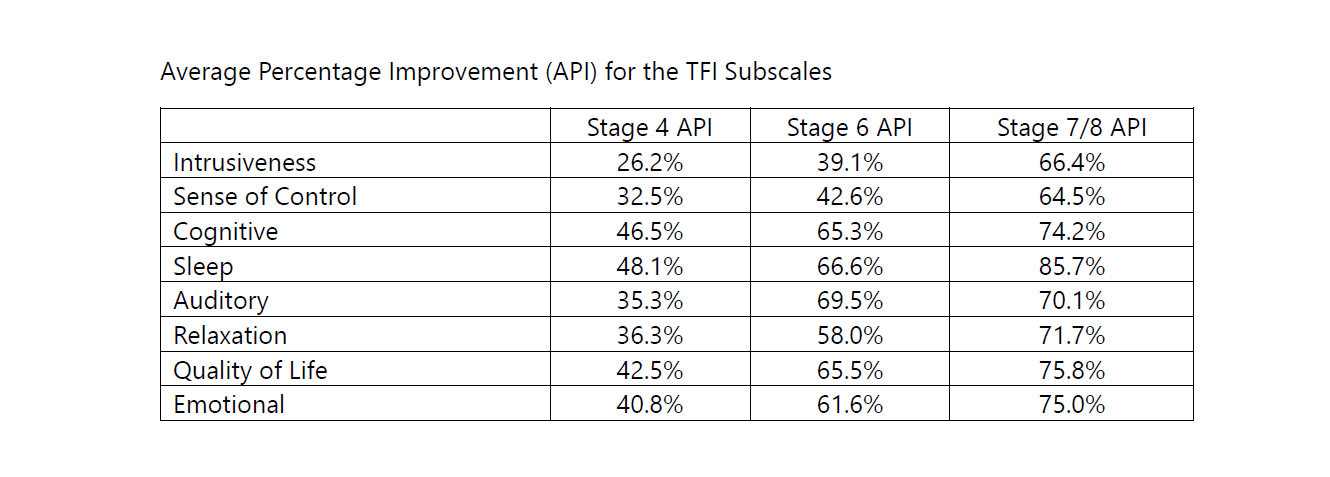
Some of these have come as a surprise even to me! For example, I was not anticipating a 66.4% improvement for the Intrusiveness subscale. CBT has no direct impact on tinnitus loudness perception. The point of CBT is more about losing interest in tinnitus so that it is no longer infesting your every thought!
Another - very pleasant - surprise was such a high percentage change (85.7%) in Sleep disturbance by Stage 7/8. I was less surprised by the 48.1% improvement by Stage 4 (a significant improvement is to be expected given the practices during Stages 1-4), but to have improved by almost a further almost 40 to 85.7% by Stage 7/8 is brilliant!
To date, work has begun on the first four TFI Subscales. Links to each of them as follows:
I will update the CBT4T Substack once the remainder of the Subscales are completed.
Useful links:
Reviews & Feedback from CBT4T Users - Each person has taken the trouble to provide comprehensive feedback for others looking for help to deal better with tinnitus, anxiety and stress
CBT4T Online – monthly subscription: https://courses.tinnituseprogram.org/cbt4t-online
CBT4T Online with ONE appointment included: https://courses.tinnituseprogram.org/cbt4t-1b
Complete a Tinnitus Functional Index (TFI)